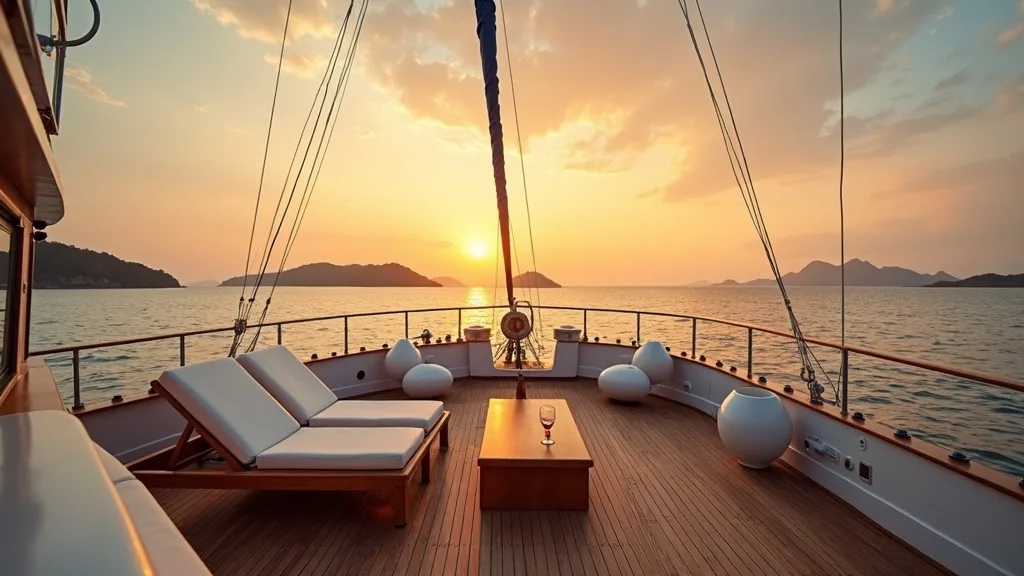
On a phinisi, where your cabin sits matters more than how big it is. A typical Raja Ampat charter vessel is 30–45 m with 5–7 air-conditioned cabins for 10–14 guests and a crew of 10–15. Main-deck cabins ride best; lower-deck twins are quietest for sleeping but feel the most motion.
What is a phinisi, and why does the layout matter?
A phinisi is a traditional Indonesian wooden sailing hull, built in South Sulawesi and adapted over the past few decades into the region’s dominant charter platform. The hull shape is long, narrow and deep — which is why cabin position on a phinisi has more effect on your night than cabin category does. On a wide modern motor yacht every berth rides similarly. On a phinisi, the difference between the master suite aft on the main deck and a twin forward on the lower deck is the difference between two entirely different trips.
Typical Raja Ampat charter vessels run 30 to 45 metres overall, carry 10 to 14 guests in five to seven cabins (usually one master suite plus deluxe and twin cabins, mostly ensuite), and run a crew of 10 to 15. Flagship phinisi reach 45 to 51 metres with seven to nine suites.
How do the cabin types actually differ?
| Cabin | Usual position | Bed | Motion felt | Engine noise | Natural light | Best for |
|---|---|---|---|---|---|---|
| Master suite | Main deck, aft or amidships | King | Least | Low to moderate | Large windows | Couples, motion-sensitive guests, the group’s organisers |
| Main-deck deluxe | Main deck | Queen or king | Low | Low | Good windows | Couples wanting comfort without the master premium |
| Lower-deck double | Below main deck, amidships | Double | Moderate | Moderate | Portholes only | Sound sleepers; the darkest, coolest cabins |
| Lower-deck twin | Below main deck, often forward | Two singles | Most, especially forward | Moderate to high near the engine room | Portholes or none | Friends sharing, children, budget-conscious divers |
| Upper-deck cabin (some vessels) | Above main deck | Queen | More roll, less pitch | Lowest | Best views | Light sleepers who are not motion-sensitive |
Where does a phinisi actually move?
Three forces, and they act on different parts of the boat:
- Pitch — the bow rising and falling — is worst forward and mildest amidships. If you are prone to seasickness, avoid the forward twins on overnight legs.
- Roll — side to side — is felt most on the upper decks, because they are furthest from the centre of gravity. An upper-deck cabin is quiet and beautiful and rolls the most at anchor in a swell.
- Vibration and engine noise — worst in lower-deck cabins adjacent to the engine room, usually amidships or aft below.
Amidships on the main deck is the compromise that wins on every axis except price. This matters more in Raja Ampat than in compact cruising grounds, because northern and southern routes involve real overnight passages — Sorong or Waisai to Misool is ten to fourteen hours under way. Our guide to seasickness on a Raja Ampat charter covers which specific legs move.
What do typical layouts look like?
| Configuration | Vessel size | Guests | Cabin mix | Crew |
|---|---|---|---|---|
| Compact 3–4 cabin | 25–32 m | 6–8 | 1 master + 2–3 doubles/twins | 8–12 |
| Standard 5 cabin | 30–40 m | 10–12 | 1 master + 2 deluxe + 2 twin | 10–14 |
| Large 7 cabin | 38–45 m | 12–14 | 1 master + 3 deluxe + 3 twin | 12–15 |
| Flagship 7–9 suite | 45–51 m | 14–20 | Multiple suites, some with private terraces | 15+ |
Guest-to-crew ratios on phinisi are generous by any standard — often close to one to one. That is not extravagance; a wooden hull, a tender operation, a dive deck and a galley producing three meals a day for a dozen people in a place with no resupply simply needs the hands. Bigger vessels and their layouts are covered on our superyacht and motor yacht charter page.
How should a group allocate cabins?
A short, practical protocol that prevents most on-board friction:
- Motion sensitivity outranks seniority. Whoever gets seasick takes the main-deck amidships cabin, regardless of who is paying.
- Light sleepers go up, not down. Engine noise below deck is constant on passage nights; deck noise above is intermittent.
- Families with young children take adjacent lower-deck cabins. Dark, cool and close together beats scenic and scattered.
- Early-rising divers should not be next to late-drinking non-divers. Obvious, routinely ignored.
- Rotate on longer charters. On ten to twelve nights, swapping the master halfway is a gracious move that costs nothing — one reason the group and corporate charter format works well for mixed parties.
What does “ensuite” really mean on a phinisi?
Usually a compact private bathroom with a marine toilet, a hand basin and a shower head in the same space — a wet room rather than a separate cubicle. Hot water is normally available but generator-dependent, so it can be timed. Water pressure is modest and fresh water is finite: a watermaker or tankage has to serve a dozen guests and a dozen crew for a week with no resupply. Short showers are a courtesy, not a rule.
Marine toilets take nothing but what the body produces and the paper the boat provides — often not even that. The crew will brief you on day one, and the briefing is worth listening to: a blocked head on an overnight passage to Misool is an unglamorous problem.
Air conditioning: what to expect
Cabins on charter phinisi are air-conditioned, and it works — but it runs off generators, so it is quieter and colder at anchor than under way, and some vessels reduce output overnight. Lower-deck cabins hold cool air best because they have the least glazing. Main-deck cabins with large windows warm quickly in afternoon sun and need the curtains drawn from midday. Neither is a defect; both are worth knowing before you choose.
Frequently asked questions
Which is the best cabin on a phinisi?
Main deck, amidships. It has the least pitch, moderate roll, good light and manageable engine noise. The master suite is usually there or just aft of it, which is why it commands the premium.
Are all cabins ensuite?
On most modern charter phinisi, yes — “mostly ensuite” is the honest phrasing, because some older vessels retain one or two cabins sharing a bathroom. Always confirm for the specific boat rather than assuming.
Can a family of four share one cabin?
Rarely comfortably. Two adjacent twins usually work better than one crowded double. Tell us the ages at enquiry and we will match the layout rather than the price.
Do twin cabins cost less on a charter?
On a full-boat charter you pay per boat per night, so cabin category does not change the invoice — only the internal allocation. On per-cabin bookings it does. The economics of both models are worked through in cabin booking versus full-boat charter.
Is there power for charging camera batteries?
Yes — cabin and saloon sockets, generally 220 V. Inverter capacity is finite, so heavy chargers and dive-light banks are best run while the generator is on. Connectivity and power questions are covered together in our note on Wi-Fi and Starlink on a Raja Ampat charter.
How do I see the actual layout of the boat offered to me?
Ask for the general arrangement plan, not just photographs — it shows cabin positions relative to the engine room and the bow, which the photographs never do. We send it with every quote. Komodo Luxury has operated Indonesian charters since 2015; the wider fleet sits at Komodo Luxury. WhatsApp +62 811 3823 875 or [email protected]. If your group has an early-rising birder in it, allocate their cabin near the companionway — our birdwatching guide explains why they will be up at 04:30. And for how the boat behaves inside a protected area, see chartering responsibly.