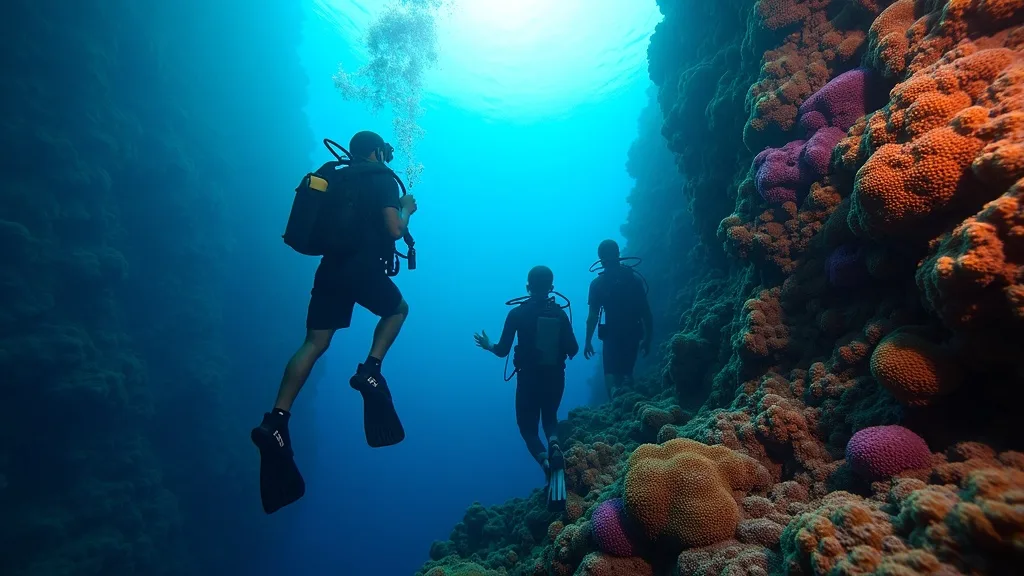
You do not need scuba to experience Raja Ampat. A large share of its signature scenes — manta cleaning stations at 5–18 m, jetty reefs at 3–20 m, hard-coral gardens from 5 m, karst viewpoints, villages and jungle rivers — sit within reach of a snorkeller or a passenger who never gets wet at all.
Can you enjoy Raja Ampat without diving?
Yes, and the reason is geological rather than promotional. Raja Ampat’s reefs grow right to the surface. Where many destinations put their best structure at 25 metres, here the hard-coral gardens start at three or five metres, the fish schools stack over shallow ridges, and the manta cleaning stations sit in water shallow enough that a snorkeller on the surface watches the same animals the divers are kneeling in front of.
Add the parts of the trip that have nothing to do with breathing gas — karst viewpoints, village visits, a spring-fed river, birds of paradise at dawn, tender cruises through limestone islets — and a non-diver’s itinerary is not a consolation version. It is a different, and for some travellers a better, trip.
Which sites work best from the surface?
| Site | Depth from surface | Current | What you see | Swimmer confidence needed |
|---|---|---|---|---|
| Manta Sandy | 5–18 m below you | Mild to moderate | Reef mantas on the cleaning station | Moderate — boat-tended |
| Arborek Jetty | 5–20 m | Mild | Schooling fish under the pilings, giant clams | Low |
| Yenbuba / Yenwaupnor jetty | 3–20 m | Mild | House reef straight off the ladder | Low |
| Sauwandarek | 3–15 m | Mild | White-sand spit, shallow reef, giant clams | Low |
| Melissa’s Garden (Fam) | 5–30 m | Mild to moderate | Dense hard-coral garden | Moderate |
| Mioskon | 5–25 m | Mild | Wobbegong sharks under ledges, macro life | Low to moderate |
| Friwen Wall | 3–25 m | Mild | Soft-coral wall visible from the surface | Low |
The pattern is clear: the beginner-friendly sites are not the leftovers. Mioskon’s wobbegongs, Arborek’s fish clouds and Manta Sandy’s cleaning station are on every diver’s list too. What a snorkeller gives up is the drift adrenaline of Cape Kri and Blue Magic — sites that demand advanced skills anyway. The full site picture, with depths and currents, is in our dive sites guide.
How do you run one boat for divers and non-divers?
This is the practical question behind most enquiries, because groups are rarely uniform. On a fixed-departure liveaboard the answer is usually “the divers set the schedule and the snorkellers fit around it”. On a full-boat charter you can do better:
- Split the tender. One tender drops divers on the drop point; a second takes snorkellers to the shallow end of the same reef. Everyone surfaces with the same story.
- Stagger the day. Divers take the early slack-water slot; snorkellers get the mid-morning one when light is best at three metres.
- Trade a dive for a land day. On a private boat, dropping the third dive in favour of a village or a waterfall is a decision your group makes, not the operator.
- Put a guide in the water with the snorkellers. Not a lifeguard on the boat — an in-water guide who points out the wobbegong you would have swum past.
That flexibility is the argument for exclusive use. The economics of it — and where the break-even sits against per-cabin bookings — are worked through in our comparison of cabin booking versus full-boat charter.
What if someone in the group is a weak swimmer?
Say so at booking, not on the tender. It changes site selection, not participation. Practical measures that work:
- Full-length wetsuit or a snorkel vest for positive buoyancy — floating is effortless in salt water once the panic reflex is removed.
- A pool noodle or float ring for guests who want to look down without swimming at all; the tender crew tows it.
- Jetty entries via ladder rather than backward rolls or beach entries through surge.
- Choosing Yenbuba, Sauwandarek and Arborek over Melissa’s Garden on the first day, building confidence before anything with current.
- Glass-bottom bucket or a tender drift over the shallows for guests who genuinely never want to get in.
Older travellers do this trip constantly and enjoy it. Calm anchorages, short tender rides and a boat that comes to you rather than the other way round make Raja Ampat gentler than its remote reputation suggests. Motion on the longer legs is worth understanding in advance — see seasickness on a Raja Ampat charter.
What fills the days out of the water?
| Excursion | Effort | Typical time |
|---|---|---|
| Piaynemo viewpoint staircase (about 300 steps) | Moderate, built handrails | 60–90 min |
| Wayag karst scramble | Steep, hands-on | 1.5–2 h |
| Arborek village — crafts, dance, jetty | Easy | 1–2 h |
| Sawinggrai bird-of-paradise hide | Easy walk, pre-dawn start | 2–3 h |
| Kali Biru freshwater river swim | Boat plus short jungle walk | 2–3 h |
| Batanta two-tier waterfall | Boat plus short forest hike | 2–3 h |
| Kabui Bay and Batu Pensil by tender | None | 1–2 h |
Any two of these turn a dive week into an expedition. The land-side excursions are mapped in detail in our guide to Kabui Bay, Kali Biru and Batanta waterfall.
Which itinerary suits a non-diving group?
Four nights covers the Dampier Strait shallow reefs plus Piaynemo — the highest scenery-to-effort ratio in the archipelago, and the reasoning behind the 4-day/3-night Piaynemo and Fam Islands charter. Five nights adds repetition on the manta station and room for villages. Seven nights is only necessary if Wayag is on your list. Longer trips add distance rather than shallow-water quality, which is the opposite of the calculus for divers.
Frequently asked questions
Can you snorkel instead of dive on a Raja Ampat liveaboard?
On a private charter, entirely. On a shared dive-dedicated boat you can, but the schedule will be built around dive profiles, and you may find yourself waiting. The distinction is worth checking before you book anything.
Will snorkellers see mantas?
Frequently. Manta Sandy’s cleaning station sits at roughly 5 to 18 metres in clear water — an easy overhead view from the surface. Our manta ray guide covers the etiquette that keeps the animals on station.
Is Raja Ampat good for children?
The shallow jetty reefs are ideal, and short sailing legs in the Dampier Strait keep young children comfortable. Longer crossings to Wayag or Misool are harder work for small passengers.
Do non-divers pay less on a charter?
On a full-boat charter, the boat rate is the boat rate — but diving is often an add-on of roughly USD 100–150 per diver per day for three dives, so a snorkeller simply does not incur it. On per-cabin bookings, dive-inclusive pricing usually makes non-divers subsidise divers.
Is there equipment on board for snorkellers?
Basic snorkel gear and towels are standard inclusions on a crewed charter. Bring your own mask if you have a face that argues with rental masks — it is the single piece of kit worth carrying.
What about guests who will not get in the water at all?
They still get the karst, the villages, the birds, the sunsets from the deck and the tender cruises. We build itineraries around them regularly. Komodo Luxury has been running Indonesian charters since 2015 — see the wider fleet at Komodo Luxury, or message WhatsApp +62 811 3823 875 / [email protected] with your group’s mix and we will design the days around it. If you are also weighing Komodo as an alternative destination, our Raja Ampat versus Komodo comparison lays out the trade-offs.